

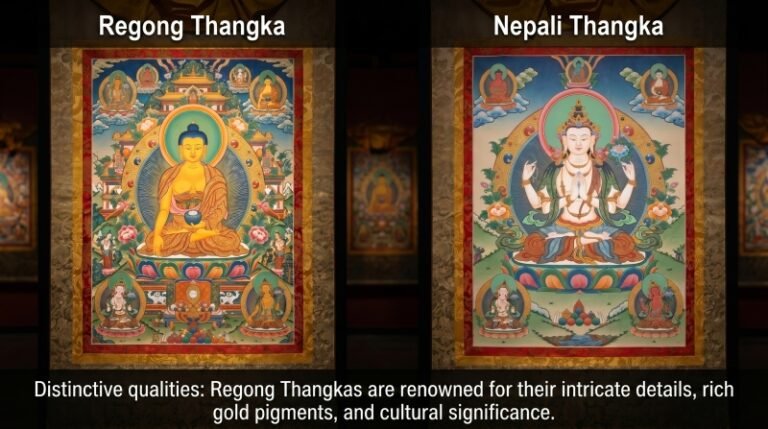
As an important part of Tibetan Buddhist art, thangka has won worldwide popularity for its exquisite craftsmanship and profound cultural connotations. When shopping for hand-painted thangka ornaments and art collections, many buyers are confused by two mainstream categories: Regong Thangka from China’s Qinghai and Nepalese Thangka from the Kathmandu Valley.
There is a noticeable price difference between the two, and their artistic value, materials and craftsmanship also vary greatly. This article will elaborate on their core distinctions, analyze the reasons for the price gap, and share practical identification tips for enthusiasts and collectors.
1. Core Differences Between Regong Thangka and Nepalese Thangka
1.1 Cultural Origin & Inheritance System
Regong Thangka
Originating from Regong (Tongren County, Qinghai, China), it is a national intangible cultural heritage with a heritage history of more than 600 years. It follows the traditional Men-Tang school of Tibetan Buddhism. Local painters receive systematic professional training from an early age and create strictly in accordance with the Measurement Sutra of Buddhist Statues. The religious norms and artistic standards are extremely rigorous, forming a standardized and orthodox inheritance system.
Nepalese Thangka
It derives from the Newari painting style of the ancient Indian Pala Dynasty and is mainly produced in the Kathmandu Valley. While high-end classical Newari thangka boasts superb artistry, most products circulating in the consumer market are made by assembly lines for tourism sales. The inheritance is loose, and the overall quality varies drastically.
1.2 Painting Style & Facial Features
Regong Thangka
It features bright, gorgeous and saturated colors, dominated by pure red, vivid blue, golden yellow and emerald green. A large number of 24K pure gold lines and gold foil are applied, presenting a soft and layered luster. The facial depiction of deities is symmetrical, gentle and solemn, which is aesthetically acceptable to most people. The overall picture is exquisite, neat and full of sacred aura.
Nepalese Thangka
The overall tone tends to be dim, with dark red, dull blue and grayish pink as mainstream colors, looking gloomy visually. The use of gold materials is limited, mostly low-cost imitation gold powder with shallow luster. The facial proportion of deities is prone to asymmetry, the lines are stiff, and the handmade texture is weak, showing an obvious mass-production style.
1.3 Raw Materials & Durability
Regong Thangka
Professional pure cotton canvas is adopted as the base. All pigments are natural mineral materials such as azurite, cinnabar and malachite, which are manually polished from natural ores. Combined with genuine 24K gold thread and gold foil, the materials are high-grade. Natural mineral pigments are stable in properties, and the colors can remain bright for hundreds of years without fading. Pure gold materials are anti-oxidant and will not turn black easily.
Nepalese Thangka
Most ordinary Nepalese thangka use common cloth as the base. The pigments are industrial acrylic and chemical paints with low cost. The so-called “gold powder” is mostly copper powder or alloy powder. Chemical pigments will gradually turn gray and fade within 3 to 5 years. Imitation gold materials are easy to oxidize and darken after long-term use, greatly affecting the appearance.
1.4 Production Cycle & Craft Mode
Regong Thangka
Every Regong thangka is purely hand-painted. From draft sketching, line drawing, coloring and gilding to the final facial finishing, all procedures are completed by professional painters independently. A regular small-sized thangka takes 30 to 60 working days to finish, and master-level works even take several months. Painters keep a devout attitude during creation and pursue details strictly.
Nepalese Thangka
Most commercial Nepalese thangka adopt assembly line production and semi-printing & hand-painting technology. Manufacturers print the basic draft by machine first, and then apprentices simply fill in colors and trace lines. One piece can be completed in only 3 to 7 days, and a single worker can finish multiple pieces every day. The production efficiency is high but the craft precision is lacking.
2. Why Is There Such a Big Price Gap?
The huge price difference between Regong thangka and ordinary Nepalese thangka is not accidental, but determined by multiple factors such as materials, labor cost, artistic value and scarcity.
2.1 Distinct Material Costs
For small and medium-sized thangka of the same specification:
- The material cost of a standard Regong hand-painted thangka including natural minerals and pure gold is far higher. High-quality ore pigments and 24K gold materials account for the main cost.
- Ordinary Nepalese thangka uses cheap chemical pigments and imitation gold powder, with extremely low material investment. The gap in raw materials directly lays the foundation for the price difference.
2.2 Huge Difference in Labor Value
Regong painters have received years of professional training and abide by strict artistic norms. Long working cycles and elaborate craftsmanship bring high labor costs. Master painters have higher artistic attainments, and their works are naturally priced higher.
Most producers of ordinary Nepalese assembly-line thangka are novice apprentices with low labor remuneration and short working hours. The overall labor cost is negligible.
2.3 Different Collection & Appreciation Value
As a certified intangible cultural heritage craft, authentic Regong hand-painted thangka is exclusive artwork. Each piece is unique with great collection and inheritance value. High-quality works will appreciate in value with the passage of time, favored by art collectors.
Most circulating Nepalese thangka are mass-produced commodities. They are easy to fade and deform, with no collection potential. They are only positioned as daily decorative ornaments, so the market price stays at a low level.
Reference Price Range (Regular Small-sized Thangka)
- Master hand-painted Regong Thangka (mineral pigments + pure gold): Mid-to-high price range, with stable collection value
- Pure hand-painted Nepalese Thangka (chemical pigments + imitation gold): Mid-low price, for daily decoration
- Semi-printed & semi-painted Nepalese Thangka: Low price, simple decorative use
- Fully printed thangka: Ultra-low price, basic ornament
3. Practical Identification Methods for Beginners
When selecting thangka, you can quickly distinguish authentic high-quality works from inferior products through the following simple methods:
3.1 Observe the facial depiction of deities (the most intuitive point)
- Authentic Regong Thangka: The facial features are symmetrical, the lines are smooth, the expression is solemn and gentle, and the details are vivid.
- Inferior Nepalese assembly-line thangka / printed thangka: Asymmetrical facial features, rigid eyes and stiff lines, lacking artistic vitality.
3.2 Check the luster and lines of gold decoration
- Regong Thangka with pure gold: The gold lines are fine and continuous, with warm and thick luster and distinct layers.
- Works with imitation gold powder: The surface is either overly dazzling or dull and dark. The gold lines are messy and intermittent with rough traces of repeated painting.
3.3 Judge color layering and transition
- Natural mineral pigments of Regong Thangka: The colors are pure and transparent, with rich layers and natural color transition after multiple times of coloring.
- Chemical pigments: The tone is turbid and grayish. The color transition is stiff, and the overall layering is single.
3.4 Check brush strokes and canvas backside
Gently observe with a magnifying glass:
- Pure hand-painted works: The pigment has a slight thickness on the surface, and the thickness of lines changes naturally. Pigment infiltration can be seen on the back of the canvas, showing irregular color spots.
- Semi-printed or fully printed products: The surface is overly flat and smooth. Regular printing dots can be seen under magnification, and the back of the canvas is clean without pigment infiltration.
3.5 Simple pigment test (operate on the edge carefully)
Dip a small amount of clear water and wipe the edge lightly:
- Natural mineral pigments: There is a fine granular touch, with slight powder dropping locally, and the color will recover after drying.
- Chemical pigments: Serious fading occurs, the water becomes turbid, and the surface color will be mottled after drying.
4. Summary
Regong Thangka represents orthodox intangible cultural heritage art, featuring premium materials, elaborate handcraft, stable color retention and high collection value. Its price matches its artistic and cultural connotation.
Most ordinary Nepalese thangka on the market are positioned as daily decorations with low cost and simple craftsmanship. They are suitable for buyers who only pursue ornamental effects.
When choosing thangka pendants, art collections or gifts, you can make a rational choice according to your own needs: if you pursue orthodox craftsmanship, collection value and long-term use, hand-painted Regong Thangka is the preferred option; if you only need daily decorative ornaments, you can choose cost-effective ordinary styles.
At ZN-Tangka, we always adhere to the inheritance of Regong traditional craft. All thangka pendants are hand-painted by certified masters from Regong Thangka Academy, equipped with high-quality solid copper gawu boxes. We insist on using natural mineral pigments and pure gold materials, presenting authentic Regong thangka art for every enthusiast.