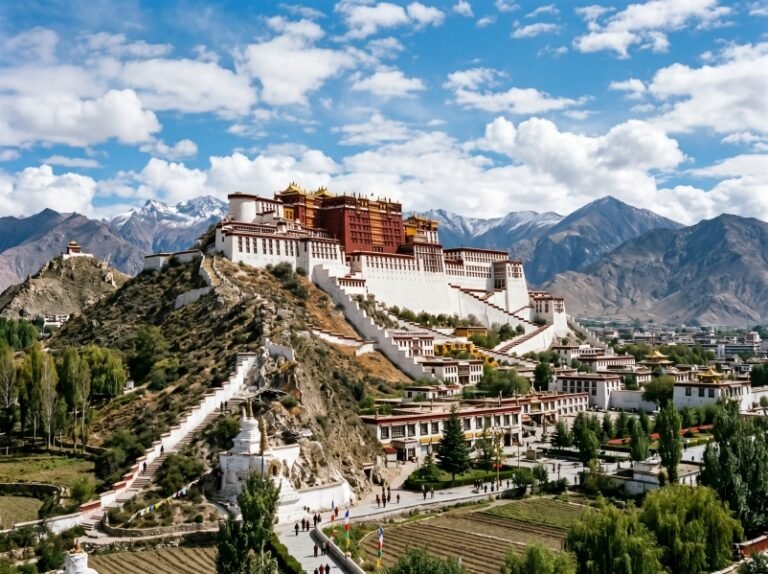
Tibetan Buddhism, also known as Vajrayana Buddhism, is a unique branch of Buddhism that blends Indian Buddhist teachings, local Tibetan culture and folk beliefs. It has a long history, distinct doctrines and exquisite traditional art, and has become an important part of Himalayan civilization.
Early Spread & Initial Development (7th–9th Centuries)
The formal introduction of Buddhism to Tibet dates back to the 7th century. During the reign of King Songtsen Gampo, diplomatic and marital exchanges between Tibet and neighboring regions promoted the spread of Buddhism. The king married Princess Wencheng from the Tang Dynasty and Princess Bhrikuti from Nepal. Both princesses brought Buddhist scriptures, statues and crafts to Tibet, and funded the construction of iconic temples such as the Jokhang Temple, laying the earliest foundation for Buddhist development on the Qinghai-Tibet Plateau.
In this period, a large number of Buddhist scriptures were translated into the Tibetan language. Monks and scholars traveled between Tibet, India and inland China to learn and exchange Dharma. Buddhism gradually took root alongside the native Bon religion of Tibet, starting a long process of cultural integration.
Prosperous Era & Institutional Improvement (10th–14th Centuries)
After a period of setbacks, Tibetan Buddhism entered a golden age starting from the late 10th century, known as the Later Propagation of Buddhism. Many Tibetan believers went to India to invite eminent monks back to preach Dharma, and Indian Buddhist masters also traveled to Tibet to spread teachings. Classic tantric doctrines, meditation methods and ritual systems were fully introduced and localized.
Different religious schools gradually formed during this period, including Nyingma, Kagyu, Sakya and Gelug, each with its own inheritance, doctrines and monastic rules. Large-scale monasteries were built across the region, which served not only as places of worship and practice, but also as centers for education, culture and art. Monasteries preserved scriptures, paintings, sculptures and handicrafts, becoming the carriers of Tibetan civilization.
Cultural Fusion & Art Inheritance (15th–19th Centuries)
From the 15th century onward, the Gelug School gradually grew influential and became the mainstream school of Tibetan Buddhism. Religious beliefs were deeply integrated into people’s daily life, etiquette, festivals and customs, forming a complete set of folk religious culture.
This era also witnessed the full bloom of Tibetan Buddhist art. Thangka painting, Buddha sculpture, temple architecture and religious rituals reached unprecedented heights. Regong Thangka, as a representative intangible cultural heritage, was passed down from generation to generation. Artists used natural mineral pigments, pure gold and traditional painting techniques to create sacred and delicate religious artworks. These handcrafted art pieces combined religious meaning and aesthetic value, and have been well-preserved to this day.
Modern Inheritance & Worldwide Influence (20th Century – Present)
In modern times, Tibetan Buddhism continues to inherit its traditional doctrines, culture and crafts while embracing communication with the outside world. Ancient monasteries and classic handicrafts such as thangka are well-protected as precious cultural heritage. Traditional hand-painted thangkas, Buddha statues and religious ornaments are no longer merely religious supplies, but also outstanding works of folk art favored by collectors and culture lovers around the world.
Nowadays, Tibetan Buddhism carries forward the core concepts of compassion, kindness, inner peace and blessing. Its unique culture, art and spiritual philosophy have spread across the globe. Traditional craftsmanship represented by Regong Thangka is still practiced by master painters, passing down centuries-old skills and cultural connotations. It connects history, tradition and modern life, and continues to radiate unique cultural charm.