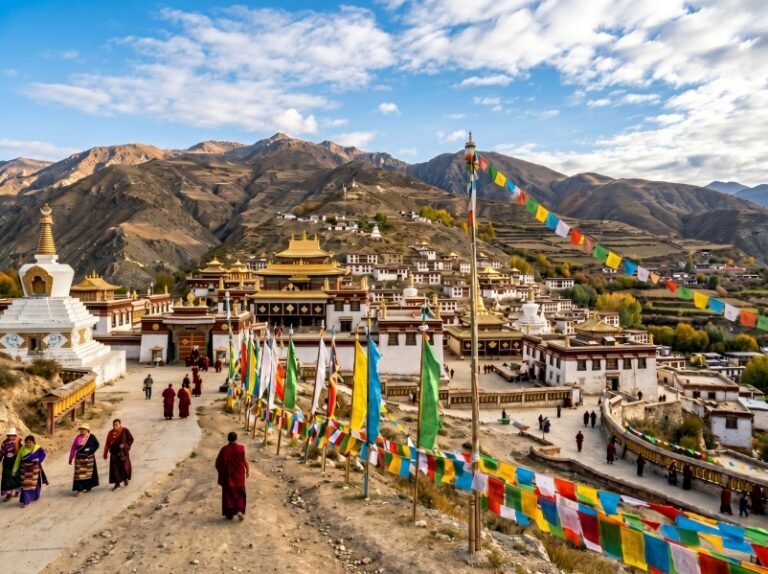
Nestled in the Longwu River Valley on the northeastern Qinghai-Tibet Plateau, Regong—literally meaning Golden Valley in the Tibetan language—is the birthplace of Regong Thangka, a world-class intangible cultural heritage of humanity. More than a traditional Tibetan painting, Regong Thangka embodies millennial faith, folk wisdom, and artisan dedication of Tibetan people. As a living ancient art rather than a mere decorative artwork, it preserves generations of cultural persistence and pure spirituality, standing as one of the most precious traditional art treasures of East Asia.
A Millennium of Evolution: From Foreign Techniques to an Independent Art School
The development of Regong Thangka spans nearly a thousand years. It has evolved steadily through cultural integration rather than abrupt transformation, forming a complete and vibrant artistic development system with four distinct stages.
9th–13th Centuries: Origin and Initial Development
As Tibetan Buddhism spread across the Regong region, painting techniques from Nepal and central Tibet were introduced to the valley. Early local artists learned from foreign artistic styles and created works by combining imported craftsmanship with indigenous Tibetan aesthetics. Though simple and heavily influenced by external art, these early pieces laid a solid foundation for the formation of Regong Thangka.
13th–17th Centuries: Stylistic Formation and Maturity
The prosperity of Longwu Temple boosted local religious and cultural vitality, attracting numerous folk painters to engage in Thangka creation. Moving beyond simple imitation, local artists absorbed the strengths of famous Tibetan painting schools—Mian Tang and Qin Zi—and integrated unique aesthetic characteristics of the Qinghai-Tibet Plateau. Gradually, they established an independent Regong Thangka style defined by exquisite lines, mild and harmonious colors, full compositions, and vivid deity portraits.
Late 17th Century–Mid-20th Century: Golden Age and Peak Prosperity
During this period, Regong painters achieved groundbreaking artistic breakthroughs while strictly following traditional Buddhist painting norms. Many master artisans traveled extensively to Tibet, Mongolia, Nepal, and India to study fine arts and collect creative inspiration. By integrating diverse global artistic essence into local creation, Regong Thangka reached its artistic peak and gained widespread fame throughout the entire Tibetan-inhabited area.
Contemporary Era: Diversified Inheritance and Global Revitalization
Breaking the traditional boundaries of religious temple decoration, modern Regong Thangka has stepped out of the Qinghai-Tibet Plateau and entered the global art scene. While well-preserving ancient craftsmanship and core traditions, contemporary painters adapt their creations to modern aesthetic trends, injecting new vitality into this thousand-year-old art. In 2009, Regong Art was officially inscribed on the UNESCO List of Intangible Cultural Heritage of Humanity.
Humanistic Heritage: Lifelong Practice and Generational Persistence
The greatest charm of Regong Thangka lies not in its gorgeous appearance or delicate craftsmanship, but in its profound humanistic warmth. Villages including Wutun, Nianduhu, and Guomari in Regong uphold an age-old tradition: every household nurtures painters, and every resident understands Thangka art. For local people, Thangka painting is never merely a livelihood trade, but a lifelong spiritual practice and sacred inheritance.
Regong Thangka follows strict ancestral rules passed down through generations. Most painters inherit the craft from their fathers and start learning painting at a young age. The apprenticeship is extremely rigorous and arduous. Young learners must first master complex religious figure proportions, standard composition rules, and fundamental skills including line drawing, flat coloring, and color blending. It takes years of diligent practice for an apprentice to create an authentic Thangka independently. Every creation requires absolute sincerity and reverence; any minor flaw means the work must be redone from scratch—a timeless principle upheld by Regong artisans for centuries.
The life stories of senior masters perfectly interpret the spirit of Regong Thangka. Dou Ga, a national-level inheritor of intangible cultural heritage, inherited family craftsmanship from childhood and devoted himself to polishing his painting skills. In his adulthood, he traveled across Tibetan regions to visit renowned masters and study ancient Thangka works. Adhering strictly to ancient traditions throughout his life, he only uses pure natural mineral and plant pigments, including gold, silver, cinnabar, turquoise, and lapis lazuli. Artworks made with these natural materials retain their bright, elegant colors for centuries without fading. Despite his prestigious reputation, Master Dou Ga remains humble and dedicated, offering free professional training to disciples and passing down his lifelong skills unreservedly to protect this precious local cultural heritage.
In past centuries, Regong painters traveled far and wide with painting tools, creating Thangkas and murals for temples across regions. They endured harsh living conditions and focused wholeheartedly on their creations, pursuing no fame or fortune. For local Tibetan people, every Regong Thangka is a sacred spiritual sustenance. Beyond depicting Buddhas, Bodhisattvas, and Buddhist legends, these artworks carry people’s sincere prayers for peace, kindness, and a better life.
Beyond Paintings: The Exquisite Craftsmanship of Eastern Sacred Art
Distinct from ordinary paintings, Regong Thangka represents the pinnacle of handcrafted art. Every procedure—from canvas polishing and natural pigment grinding, to line sketching and layered coloring—is completed purely by hand with rigorous and complicated standards. A single high-quality Regong Thangka often takes several months or even years of concentrated effort from skilled painters.
Regong Thangka features unique and recognizable artistic aesthetics. Its color palette is mild, layered, and elegant, delivering a tranquil and soothing visual experience without harsh tones. Boasting precise and fluent lines, vivid character expressions, and balanced integrated compositions, each Thangka perfectly combines supreme artistic beauty and profound spiritual power.
Today, the ancient Golden Valley still witnesses the continuous inheritance of Thangka art. Young local painters take over the brushes from their elders, adhering to traditional craftsmanship while embracing global artistic perspectives to promote Regong Thangka worldwide. After a thousand years of inheritance and evolution, Regong Thangka has transcended the definition of pure artwork. It serves as a carrier of Tibetan people’s faith, a symbol of generational artisan spirit, and a distinguished cultural business card showcasing traditional Chinese art to the world.